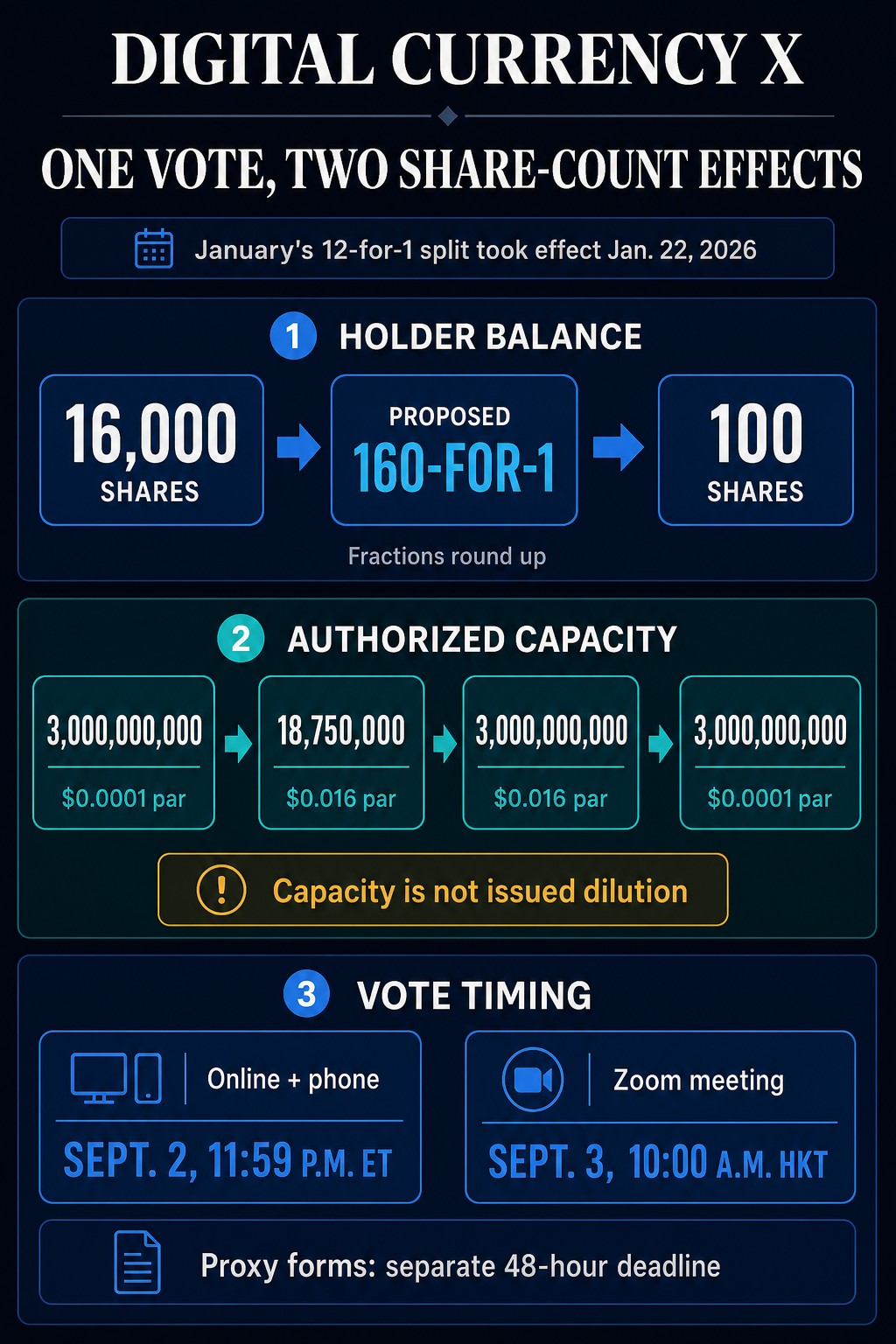
Nasdaq-listed Digital Currency X Technology Inc. is asking shareholders to approve a 160-for-1 reverse stock split, also known as a share consolidation, on September 3. It would be the company’s second consolidation of 2026 after a 12-for-1 action took effect on January 22.
Digital Currency X recently shifted from electric-vehicle manufacturing into the digital asset sector. In its latest annual report, the company said its treasury held 157.45 million EDGEAI tokens. It valued them at about $402 million as of December 31, 2025. It later locked all of those tokens in a 12-month staking agreement. The agreement carried a floating annualized yield of 3.5% to 8%.
For a holder whose balance is divisible by 160, every 160 Class A or Class B shares would become one share. A holder of 16,000 shares, for example, would receive 100. The filing says the company would round fractional results up to the nearest whole share, so smaller or nondivisible positions would not follow that arithmetic exactly. The consolidation would cover both issued and unissued shares. It would take effect on a date confirmed by Nasdaq or one on which the exchange raises no objection.
A reverse stock split, then an authorization reset
The first resolution would reduce authorized shares from 3 billion, each with a par value of $0.0001, to 18.75 million, each with a $0.016 par value. A second resolution would immediately increase the authorization back to 3 billion shares at the higher par value. A third would reorganize the authorized share capital back to $0.0001 per share. Shareholders had approved the 3 billion-share authorization on May 13, according to a May filing.
Authorized shares are capacity, rather than stock already issued. The resolutions would not themselves issue shares or prove immediate dilution, but they would leave the company able to issue far more shares after the consolidation than the 18.75 million-share ceiling created by the first step alone.
Share base and voting timeline
The disclosed issued-share figures come from two earlier dates and establish only a floor. Digital Currency X’s annual report listed 19,823,627 Class A shares and 1,334 Class B shares outstanding as of April 20. A July 7 filing then said the company issued 331,753,557 units, each including one Class A share and warrants, at a July 3 private-placement closing. Together, those disclosures establish at least 351,577,184 Class A shares plus 1,334 Class B shares before any later warrant exercise or other issuance.
Class A shares carry one vote each on general-meeting matters, while Class B shares carry 20. On the April counts, the Class B class represented 26,680 votes against more than 19.8 million Class A votes. The July issuance added Class A shares, but the materials do not establish current holder-by-holder control for the September vote.
The company said it intended January’s consolidation to help regain Nasdaq minimum bid-price compliance. By contrast, the August meeting notice does not identify a compliance, financing, or offering rationale for the proposed 160-for-1 reverse stock split and capital reorganization. Intervening issuance also changed the share base, so the two ratios do not describe one continuous holder-level reduction.
The Zoom-only meeting is scheduled for 10:00 a.m. Hong Kong time on September 3. Internet and phone voting closes at 11:59 p.m. Eastern time on September 2, while proxy forms have a separate deadline no later than 48 hours before the meeting.
