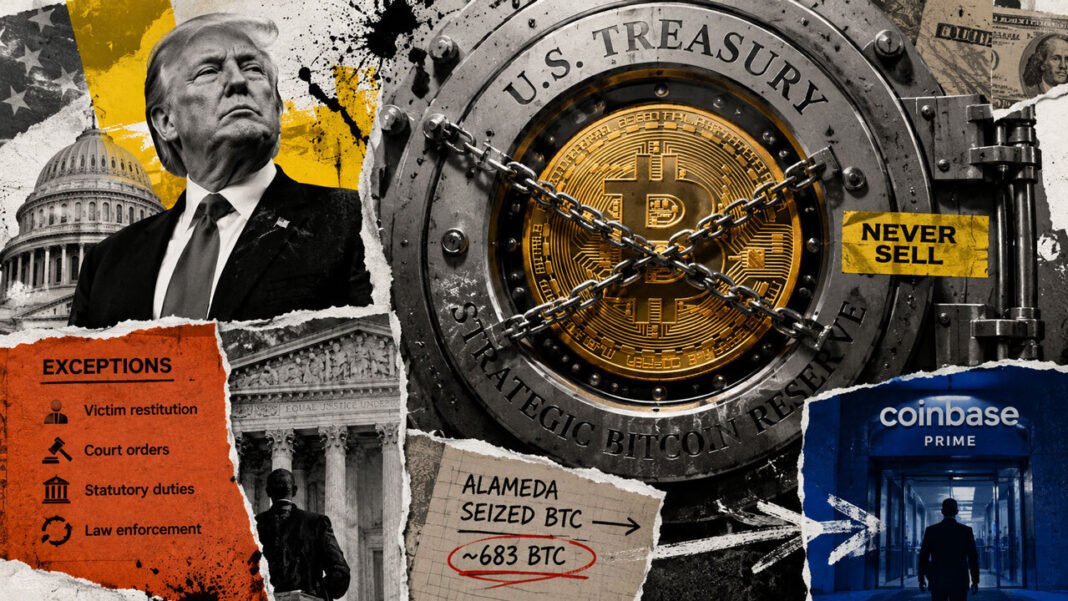
A wallet tagged to the US government moved a small amount of Bitcoin linked to assets seized from Alameda Research’s Binance.US accounts.
The movement revives a familiar fear that Washington could be preparing to liquidate more of its forfeited Bitcoin stash.
Bitcoin deposited into the Strategic Bitcoin Reserve “shall not be sold” under President Donald Trump’s March 2025 executive order, turning qualifying forfeited BTC into a long-term Treasury asset.
Trump himself said on Aug. 19 that he had made Bitcoin “a permanent asset of the United States Treasury.”
| Category | Covered by reserve sale ban? | Why it matters |
|---|---|---|
| Seized BTC | Not automatically | Government control alone does not make BTC part of the reserve. |
| Finally forfeited BTC | Potentially | This is the legal threshold needed before BTC can qualify. |
| Treasury-held forfeited BTC | Yes, if not needed elsewhere | This is the core category the reserve protects. |
| BTC needed for victim restitution | No / exception applies | The order allows return or disposal to compensate identifiable victims. |
| BTC subject to court orders or statutory duties | No / exception applies | Courts and forfeiture-fund rules can override the hold policy. |
| WBTC or other non-BTC assets | No | These fall under the separate Digital Asset Stockpile, not the Strategic Bitcoin Reserve. |
The order protects a limted category
The reserve’s sale ban applies only to Bitcoin forfeited, held by the Treasury, and not needed for statutory obligations.
The same order separately permits agency heads to dispose of government-controlled digital assets under specific exceptions, including court orders, legal requirements, return to identifiable and verifiable crime victims, law-enforcement operations, and statutory forfeiture-fund requirements.
Court records in US v. Bankman-Fried list roughly 682 BTC seized from two Alameda Research accounts at Binance.US, split between 657.92 BTC in one account and 24.4135385 BTC in another.
One smaller 1.3773854 BTC transaction brings the full Alameda native-BTC total to about 683.71 BTC, worth roughly $53.6 million at a BTC price near $78,463.
Those coins sit inside an $11 billion forfeiture order tied to Alameda’s collapse, and the Department of Justice has already drawn on that order to pay victims directly.
The Department of Justice’s fiscal 2025 financial statements show the US Marshals Service received a $627.9 million interbank settlement in October 2025 as partial payment toward the Alameda forfeiture.
WBTC is a different legal animal entirely
The same Alameda schedule also lists about 750.72 WBTC, a separate legal category entirely.
Trump’s order creates the Strategic Bitcoin Reserve specifically for BTC, alongside a separate US Digital Asset Stockpile for other digital assets, where the Treasury Secretary retains discretion over stewardship strategies, including potential sales.
WBTC’s economic link to Bitcoin does not make it legally equivalent to BTC deposited in the reserve.
CryptoSlate found public trackers estimating US-controlled Bitcoin anywhere between roughly 198,000 and 328,000 BTC, a gap of about 130,000 BTC worth close to $10.2 billion at current prices.
| Label used by trackers | What it may actually mean | Can it be sold or moved? |
|---|---|---|
| Government-controlled | A wallet is tagged to a US agency or seizure | Yes, depending on legal status |
| Seized | Assets taken into custody during an investigation | Not necessarily final government property |
| Forfeited | Ownership transferred through criminal or civil forfeiture | Potentially reserve-eligible |
| Treasury-held | Assets held by Treasury after forfeiture | More likely to qualify for reserve treatment |
| Reserve-owned | BTC deposited into the Strategic Bitcoin Reserve | Sale prohibited under the EO |
| Restitution-linked | Assets tied to victim compensation | Can be disposed of under the EO’s exceptions |
That discrepancy exists because terms like seized, forfeited, government-controlled, and reserve-owned describe genuinely different legal categories that trackers routinely treat as interchangeable.
Some of Alameda’s seized Bitcoin could plausibly qualify as protected reserve assets, while other portions remain tied to an active restitution process that Trump’s own order explicitly permits to continue.
What today’s confirmed Bitcoin movement could still mean
Reports from May noted that a US-government-labeled wallet sent about $1.9 million of seized Alameda altcoins to Coinbase Prime, tracing back to 2023 DOJ seizures from Alameda’s Binance and Binance.US accounts.
A larger movement happened in July, with about $297 million of seized BTC and ETH sent to Coinbase Prime, which supports custody, institutional asset management, and sales.
Bitcoin bull’s best-case scenario has Alameda’s native BTC moving down a transparent path, either finally forfeited and folded into the reserve under Trump’s order or disbursed to victims under the restitution process the order already permits.
Under that path, the “never sell” promise stays credible for the Bitcoin it covers, and the Alameda case becomes a clean precedent for how future forfeitures get classified.
| Scenario | What happens | What it would imply |
|---|---|---|
| Administrative movement | Coins are moved for custody, consolidation, or accounting | No direct sale signal; reserve uncertainty remains. |
| Reserve absorption | Native BTC is finally forfeited and assigned to the Strategic Bitcoin Reserve | Strengthens the “permanent Treasury asset” claim. |
| Victim restitution | Coins are sold, converted, or distributed to compensate victims | Legal under the EO, but not part of the reserve promise. |
| WBTC disposal | Wrapped BTC or other non-BTC assets are sold or managed separately | Shows why WBTC is not legally equivalent to reserve BTC. |
| Opaque liquidation | Assets are disposed of without clear public classification | Reopens the 198,000–328,000 BTC accounting gap. |
Bears would have the transfer resolving into a liquidation for restitution purposes without clear public accounting, adding another entry to the same classification gap that already separates trackers by roughly 130,000 BTC.
In that scenario, each new government wallet movement reopens the same unanswered question. Whether the coins involved were ever inside the reserve Trump has called permanent is a question the public still lacks the means to verify.
Washington’s Bitcoin has never been one undifferentiated pile the government can simply keep or spend. Alameda’s seized coins sit on the line between a reserve that cannot be touched and a forfeiture process always designed to pay someone back.
